Healthcare · Service Design · 2021
When PCOS stops being a lonely battle
A 4-month design research project reimagining chronic illness management as a shared, empowering ecosystem for young women and their support networks.
Role
Full-stack Designer
Duration
4 months
Type
Individual · Pre-thesis
Recognition
MIT Grand Hack
Healthcare · Service Design · 2021
When PCOS stops being a lonely battle
A 4-month design research project reimagining chronic illness management as a shared, empowering ecosystem for young women and their support networks.
Role
Full-stack Designer
Duration
4 months
Type
Individual · Pre-thesis
Recognition
MIT Grand Hack
1 in
Women affected by PCOS
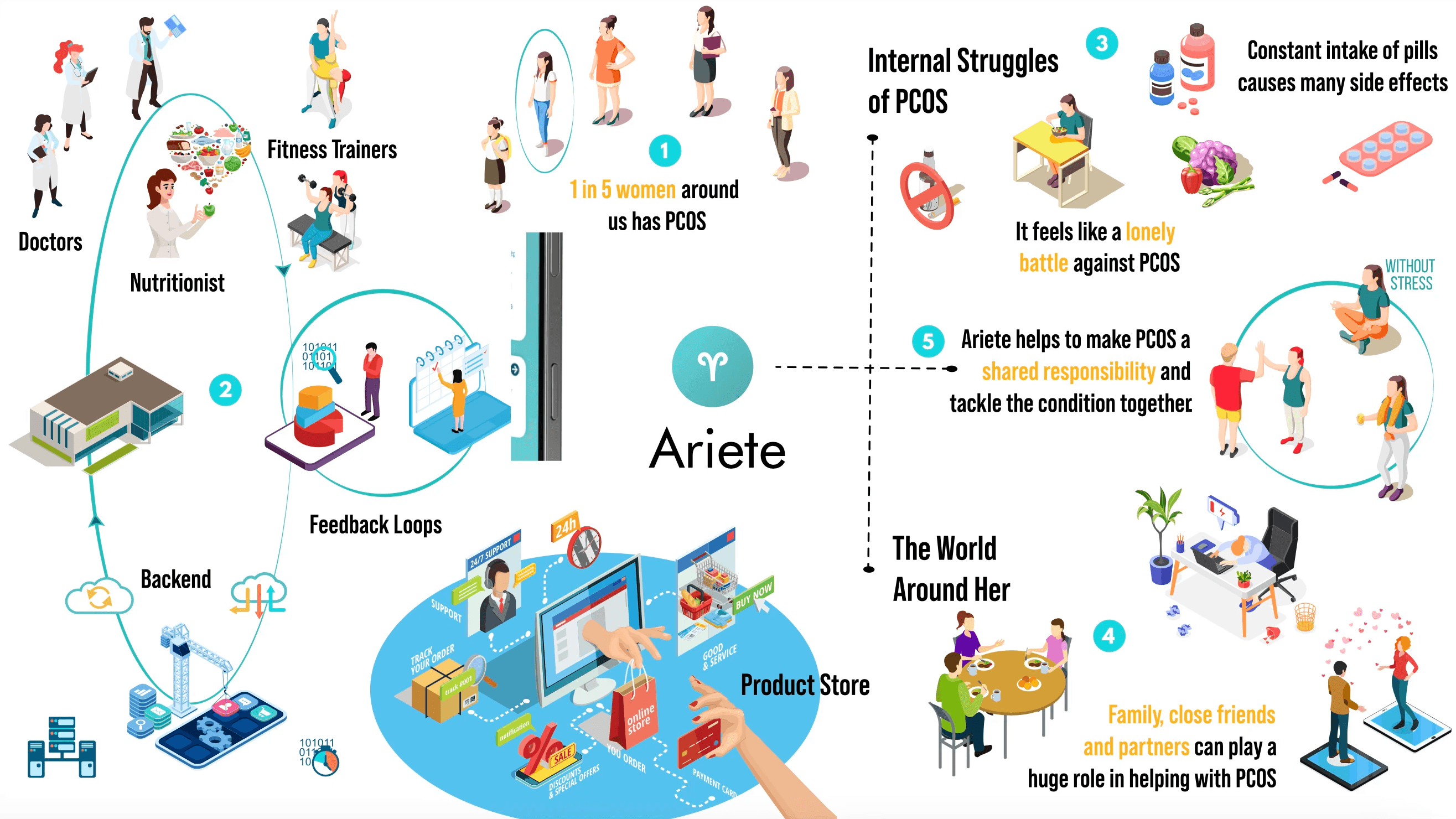
Most women manage PCOS in isolation — from their partners, families, and healthcare systems. This project asked: what if we changed that?
pg
Research documentation
The Problem
The Problem
PCOS is one of the most common hormonal conditions in women of reproductive age — yet it remains widely misdiagnosed, misunderstood, and isolating. Women are handed a diagnosis and a pamphlet. Partners feel helpless. Existing apps reduce a complex condition to a calorie counter.
The real problem isn’t medical. It’s structural: there’s no ecosystem designed to hold the patient, her relationships, and her healthcare together in one place.
Research framing image
Research Methods
Research Methods
User interviews
8 women, ages 18–26. Revealed shame, inconsistent diagnosis timelines, and partner exclusion.
Journey mapping
Mapped the full patient experience from first symptom to ongoing management, surfacing systemic gaps.
Co-design workshops
Participants designed their ideal support ecosystem — consistently including close relationships in the loop.
Secondary research
Reviewed clinical literature, existing apps and support communities to map the competitive landscape.
Key Insights
Key Insights
01
Women don't lack willpower — they lack a system
Motivation collapses without consistent accountability structures that feel supportive, not clinical.
02
Partners want to help. They're just excluded by design
Care ecosystems are built for patients only. Close relationships are an untapped resource in PCOS management.
03
Apps treat PCOS as medical. Women experience it as life
Existing tools focus on symptoms and tracking. None address the emotional, relational, or identity dimensions.
Design Process
Design Process
01
Discover
Interviews, desk research, landscape audit
02
Synthesise
Journey maps, affinity mapping, insight clusters
03
Co-design
Participatory workshops with PCOS patients
04
Prototype
App flows, service blueprint, visual identity
05
Test
User testing sessions, iterative refinement
The Solution
The Solution
Full-width app screens / mockup
Track & Manage
Cycle, diet, mood and workout trackers built for PCOS-specific patterns — not generic wellness.
Sync with your circle
Share relevant data with partners and trusted people — bringing allies into the care loop.
Expert access
Connect with specialists digitally, reducing the friction between symptom and treatment.
Community + accountability
Challenges, rewards and shared experiences designed to sustain motivation long-term.
Visual Identity
A name, a look, a feeling
Ariete — Italian for ‘ram’ — references both strength and the zodiac sign most associated with PCOS onset. The brand reflects warmth, confidence, and community without clinical detachment.
Brand / visual design screens
Impact
Impact
4mo
Solo, full-stack research & design
MIT
Grand Hack — recognised at global stage
3
User groups: patients, partners, experts
92pg
Research documentation, concept to prototype
Reflection
Reflection
This project taught me that designing for sensitive health conditions demands more than empathy — it demands rigor. The decision to include partners in the ecosystem was the single most important design move, and it came directly from research, not intuition. If I were doing this again, I’d spend more time testing the social dynamics of data-sharing rather than the feature set. The hardest design problem here wasn’t the interface — it was the relationship.
Healthcare · Service Design · 2021
When PCOS stops being a lonely battle
A 4-month design research project reimagining chronic illness management as a shared, empowering ecosystem for young women and their support networks.
Role
Full-stack Designer
Duration
4 months
Type
Individual · Pre-thesis
Recognition
MIT Grand Hack
Healthcare · Service Design · 2021
When PCOS stops being a lonely battle
A 4-month design research project reimagining chronic illness management as a shared, empowering ecosystem for young women and their support networks.
Role
Full-stack Designer
Duration
4 months
Type
Individual · Pre-thesis
Recognition
MIT Grand Hack
1 in
Women affected by PCOS
Most women manage PCOS in isolation — from their partners, families, and healthcare systems. This project asked: what if we changed that?
pg
Research documentation
The Problem
The Problem
PCOS is one of the most common hormonal conditions in women of reproductive age — yet it remains widely misdiagnosed, misunderstood, and isolating. Women are handed a diagnosis and a pamphlet. Partners feel helpless. Existing apps reduce a complex condition to a calorie counter.
The real problem isn’t medical. It’s structural: there’s no ecosystem designed to hold the patient, her relationships, and her healthcare together in one place.
Research framing image
Research Methods
Research Methods
User interviews
8 women, ages 18–26. Revealed shame, inconsistent diagnosis timelines, and partner exclusion.
Journey mapping
Mapped the full patient experience from first symptom to ongoing management, surfacing systemic gaps.
Co-design workshops
Participants designed their ideal support ecosystem — consistently including close relationships in the loop.
Secondary research
Reviewed clinical literature, existing apps and support communities to map the competitive landscape.
Key Insights
Key Insights
01
Women don't lack willpower — they lack a system
Motivation collapses without consistent accountability structures that feel supportive, not clinical.
02
Partners want to help. They're just excluded by design
Care ecosystems are built for patients only. Close relationships are an untapped resource in PCOS management.
03
Apps treat PCOS as medical. Women experience it as life
Existing tools focus on symptoms and tracking. None address the emotional, relational, or identity dimensions.
Design Process
Design Process
01
Discover
Interviews, desk research, landscape audit
02
Synthesise
Journey maps, affinity mapping, insight clusters
03
Co-design
Participatory workshops with PCOS patients
04
Prototype
App flows, service blueprint, visual identity
05
Test
User testing sessions, iterative refinement
The Solution
The Solution
Full-width app screens / mockup
Track & Manage
Cycle, diet, mood and workout trackers built for PCOS-specific patterns — not generic wellness.
Sync with your circle
Share relevant data with partners and trusted people — bringing allies into the care loop.
Expert access
Connect with specialists digitally, reducing the friction between symptom and treatment.
Community + accountability
Challenges, rewards and shared experiences designed to sustain motivation long-term.
Visual Identity
A name, a look, a feeling
Ariete — Italian for ‘ram’ — references both strength and the zodiac sign most associated with PCOS onset. The brand reflects warmth, confidence, and community without clinical detachment.
Brand / visual design screens
Impact
Impact
4mo
Solo, full-stack research & design
MIT
Grand Hack — recognised at global stage
3
User groups: patients, partners, experts
92pg
Research documentation, concept to prototype
Reflection
Reflection
This project taught me that designing for sensitive health conditions demands more than empathy — it demands rigor. The decision to include partners in the ecosystem was the single most important design move, and it came directly from research, not intuition. If I were doing this again, I’d spend more time testing the social dynamics of data-sharing rather than the feature set. The hardest design problem here wasn’t the interface — it was the relationship.
Healthcare · Service Design · 2021
When PCOS stops being a lonely battle
A 4-month design research project reimagining chronic illness management as a shared, empowering ecosystem for young women and their support networks.
Role
Full-stack Designer
Duration
4 months
Type
Individual · Pre-thesis
Recognition
MIT Grand Hack
Healthcare · Service Design · 2021
When PCOS stops being a lonely battle
A 4-month design research project reimagining chronic illness management as a shared, empowering ecosystem for young women and their support networks.
Role
Full-stack Designer
Duration
4 months
Type
Individual · Pre-thesis
Recognition
MIT Grand Hack
1 in
Women affected by PCOS
Most women manage PCOS in isolation — from their partners, families, and healthcare systems. This project asked: what if we changed that?
pg
Research documentation
The Problem
The Problem
PCOS is one of the most common hormonal conditions in women of reproductive age — yet it remains widely misdiagnosed, misunderstood, and isolating. Women are handed a diagnosis and a pamphlet. Partners feel helpless. Existing apps reduce a complex condition to a calorie counter.
The real problem isn’t medical. It’s structural: there’s no ecosystem designed to hold the patient, her relationships, and her healthcare together in one place.
Research framing image
Research Methods
Research Methods
User interviews
8 women, ages 18–26. Revealed shame, inconsistent diagnosis timelines, and partner exclusion.
Journey mapping
Mapped the full patient experience from first symptom to ongoing management, surfacing systemic gaps.
Co-design workshops
Participants designed their ideal support ecosystem — consistently including close relationships in the loop.
Secondary research
Reviewed clinical literature, existing apps and support communities to map the competitive landscape.
Key Insights
Key Insights
01
Women don't lack willpower — they lack a system
Motivation collapses without consistent accountability structures that feel supportive, not clinical.
02
Partners want to help. They're just excluded by design
Care ecosystems are built for patients only. Close relationships are an untapped resource in PCOS management.
03
Apps treat PCOS as medical. Women experience it as life
Existing tools focus on symptoms and tracking. None address the emotional, relational, or identity dimensions.
Design Process
Design Process
01
Discover
Interviews, desk research, landscape audit
02
Synthesise
Journey maps, affinity mapping, insight clusters
03
Co-design
Participatory workshops with PCOS patients
04
Prototype
App flows, service blueprint, visual identity
05
Test
User testing sessions, iterative refinement
The Solution
The Solution
Full-width app screens / mockup
Track & Manage
Cycle, diet, mood and workout trackers built for PCOS-specific patterns — not generic wellness.
Sync with your circle
Share relevant data with partners and trusted people — bringing allies into the care loop.
Expert access
Connect with specialists digitally, reducing the friction between symptom and treatment.
Community + accountability
Challenges, rewards and shared experiences designed to sustain motivation long-term.
Visual Identity
A name, a look, a feeling
Ariete — Italian for ‘ram’ — references both strength and the zodiac sign most associated with PCOS onset. The brand reflects warmth, confidence, and community without clinical detachment.
Brand / visual design screens
Impact
Impact
4mo
Solo, full-stack research & design
MIT
Grand Hack — recognised at global stage
3
User groups: patients, partners, experts
92pg
Research documentation, concept to prototype
Reflection
Reflection
This project taught me that designing for sensitive health conditions demands more than empathy — it demands rigor. The decision to include partners in the ecosystem was the single most important design move, and it came directly from research, not intuition. If I were doing this again, I’d spend more time testing the social dynamics of data-sharing rather than the feature set. The hardest design problem here wasn’t the interface — it was the relationship.